 Reader Picks
The Ginkgo Line Reads 120 Milligrams. So Did the Twelve-Week Trial.
Four plants, two capsules, twenty servings to the bottle. I put every amount on the panel beside the amount its study used, and only one of the four lines up.

This is a paid advertisement. Sponsored by Gaia Herbs, Inc.
Foster Kimbrough is the pen name of this desk.
Everything on this page about the bottle comes from the maker's own product page, the photograph of its official panel, and its published terms, all read on September 20, 2026.
There is a shelf in the back of the hardware store here that has nothing to do with hardware.
Vitamins, a few herb bottles, and a card with prices written by hand.
A man I have known for thirty years stopped me in front of it last month and held up a small bottle with a dark green label.
He wanted to know whether the number on the back of it meant anything.
It is a fair question, and almost nobody answers it.
The bottle was Nootropic Focus, made by Gaia Herbs of North Carolina.
Forty liquid-filled capsules, four plants, and a panel on the back with three amounts printed on it.
Here is the method I use for every bottle that reaches this desk, and it is the only one I think is fair.
Take each amount the label prints, find the study that tested that plant, and see whether the study used that amount or a great deal more.
Sometimes the answer is flattering to the bottle. On this one it is flattering exactly once, and I will tell you which line it is.
The short version before the long one.
One plant on this panel is at the amount of a real study in people the age of the man who asked me.
One plant is at an amount close to the studies that exist, but those studies were done in people this page is not about.
And two plants share a single number with no split printed between them, so nobody outside the company knows how much of either you are swallowing.
That is not a scandal. It is an ordinary label, read carefully, which is a thing almost nobody does before they pay.
What follows is that reading, in the order I did it.
It takes a while, because a label takes a while if you do it properly, and because half of what matters is not printed on the front.
Forty Capsules, Twenty Servings, and How Many Days That Really Is
Start with the arithmetic, because the arithmetic decides what this bottle costs you and almost nobody does it in the aisle.
Forty capsules go in the bottle.
Two capsules make one serving, which is what the panel calls a serving, so the bottle holds twenty of them.
Now read the direction on the label, and read it twice.
Adults take two capsules one to two times daily, between meals, and the maker says it suits long-term use.
Twenty servings: twenty days at once a day, ten days at twice a day.
That is the whole range, and the label leaves the choice to you.
Whichever half of the direction you follow, you are buying either three weeks or a week and a half at a time.
I want that in front of you before anything else, because it changes what a test of this bottle can even be.
A man who buys one bottle, takes it twice a day and writes nothing down has bought ten mornings and no information.
It also changes the refund window, which I will come back to.
The seller gives you 45 days from the day the bottle ships, and at the upper direction that window is longer than four bottles.
There is one thing this bottle has not been tested for, and it is the bottle itself.
Nobody has ever put these four plants together in a room full of people and measured anything.
What exists is studies of the plants, one at a time, at amounts I am about to lay beside the panel.
That is a weaker thing than a study of the product, and it is the ordinary situation for almost everything on that hardware-store shelf.
Forty capsules, twenty servings, ten days at the upper direction and twenty at the lower. Decide which half you are following before you buy, because it doubles or halves what a month costs.
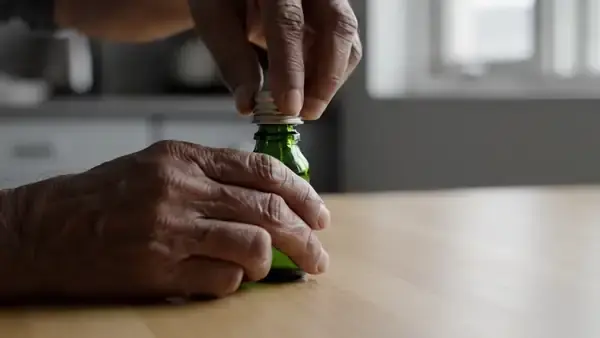
What a Liquid-Filled Capsule Actually Is
Open one and you will not find powder.
Each capsule is a shell filled with a liquid plant extract, which is a different object from the pressed powder most bottles on that shelf contain.
The shell is plant fiber, hypromellose, colored with chlorophyll.
There is no gelatin in it, which is why the label says the capsule suits people who avoid animal products.
The liquid inside is the plant extract carried in vegetable glycerin and water.
That is where the five calories and the gram of carbohydrate on the panel come from; glycerin is a sweet, syrupy carrier and it is the whole of the nutrition line.
Glycerin matters for a second reason on a page written for men over 55.
A great many herb bottles carry their extracts in alcohol, and this one does not, which is one fewer thing to count in an evening.
The maker also prints what the bottle does not contain: corn, dairy, gluten, peanuts, shellfish, soy, sugar, tree nuts and yeast.
That list is worth more than most of what gets printed on a front panel, because it is checkable and because it is the kind of thing a man with a sensitivity actually needs.
One last practical line from the label, and I appreciated it.
It says separation can happen inside the bottle and does not affect the product, which is simply what liquid plant extracts do when they sit on a shelf for a few months.
Does the liquid form do anything the powder form does not?
The honest answer is that no study on this page compared the two, and I am not going to pretend the format is a result.
A plant-fiber shell with a liquid extract in glycerin and water: no alcohol, no gelatin, no sugar, and five calories a serving. The format is a convenience, not a finding.
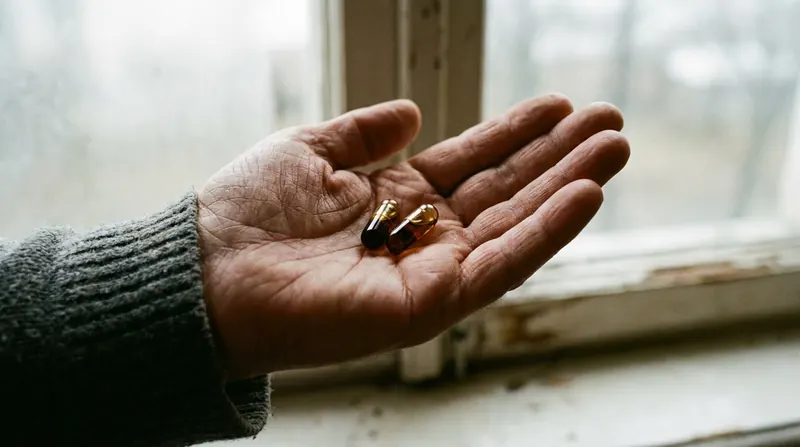
How I Read a Panel, in Three Questions
Before the plants, the method, because you can use it on anything on that shelf and it costs nothing.
The first question is what the amount is.
Not the name of the plant, not the part of the plant, not the promise on the front: the number in milligrams beside the name.
The second question is what the study used.
If there is a study of that plant in people, it gave them a specific amount every day for a specific number of weeks, and that amount is either near the bottle's or a long way above it.
The third question is who the study was in.
A result in thirty university students at nine in the morning is not the same object as a result in ninety-three adults between 55 and 79, and a label never tells you which one it is leaning on.
The number, the study's number, and the people in the study.
Most bottles fail the first question, because they print a blend and no amounts at all.
This one mostly passes it: every line on the panel carries a number, though two of the four plants have to share theirs.
Most bottles that pass the first question fail the second, because the study used two, five or thirteen times what the bottle carries.
This one fails the second question on the kitchen herbs and passes it on the ginkgo.
And almost every bottle fails the third question, because the research was done in young people and the bottle is sold to old ones.
This one passes the third question on the ginkgo and cannot answer it at all on the saffron.
That is the shape of the reading before we start.
One pass, one absence, one shared number, and a company that grows what it sells.
The Ginkgo: One Hundred Twenty Milligrams, and the Study That Used Exactly That
This is the line that made me take the bottle seriously enough to write about it.
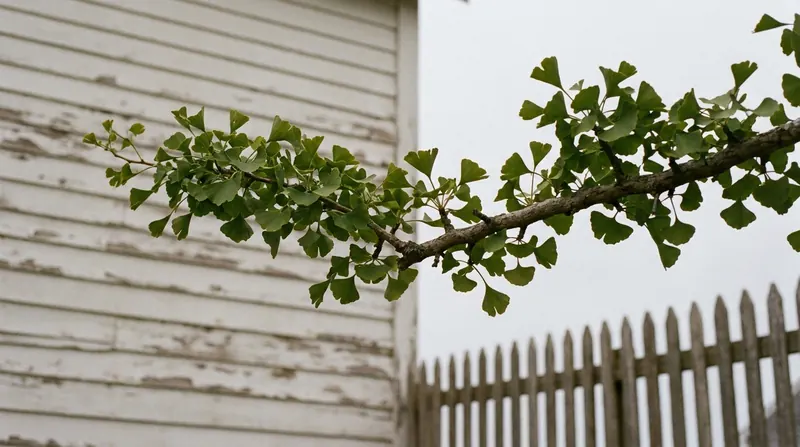
The panel prints 120 milligrams of ginkgo leaf extract in two capsules.
Ginkgo is the fan-leaved tree planted along half the main streets in this country, and its leaf extract has been sold for memory for about forty years.
Here is the study that matters for a man over 55.
Ninety-three healthy adults between 55 and 79 took 120 milligrams a day of a standardized ginkgo extract for twelve weeks, and they did better than the placebo group on tasks of learning and holding onto associations. [1]
Associational learning is the thing you are complaining about when you complain about names.
It is the work of tying one item to another, a face to a word, a word to a place, and then producing the second one when the first comes back.
So the task in that study is the right task, which is not always true.
A great many supplement studies report a faster reaction time and then let the reader assume it means something about names.
Now the limits, which belong in the same breath.
That was a moderate effect on one kind of task, and on every other measure in the study, attention, executive tasks and the rest, there was no difference worth reporting. [1]
The same study ran 104 young adults through the same twelve weeks.
In the young group there was nothing at all, which is a useful thing to know about who this plant does and does not appear to do anything for. [1]
One result out of many. At exactly the amount in this bottle.
I am not going to dress that up, and I am not going to throw it away either.
It is the one number on this panel that matches the number in a study of people the right age, and that is more than most bottles on this desk can say.

The Same Herb, Six Years and Three Thousand People Later
Any page that prints the flattering study and stops there is selling you something.
The largest ginkgo study ever run gave 3,069 adults aged 72 to 96 twice this bottle's amount, 120 milligrams twice a day, for a median of six years. [2]
They did no better than the people taking a dummy capsule on memory, attention, language, visual and spatial ability, or executive function. [2]
Read those two numbers against each other slowly.
Six years and three thousand people found nothing; twelve weeks and ninety-three people found one thing.
That is not quite the contradiction it looks like.
The big study was in people between 72 and 96, it ran for years rather than weeks, and it asked whether the herb changed the long slope of ordinary aging.
The small study was in people between 55 and 79, it ran for three months, and it asked whether scores on a particular learning task were a little higher at the end.
Those are different questions, and the herb answered one of them weakly and the other one not at all.
What you should take from the pair is a sense of scale.
If there is anything here, it is small, it shows up on some tasks and not others, and it does not bend the long line.
The National Institutes of Health's center for complementary health puts it flatly.
There is no conclusive evidence that ginkgo is helpful for any health purpose. [3]
I could have left that sentence out and nobody would have known.
It is in because you deserve to see the official position beside the best number on the label, and because a page that only prints the good study is not worth your ten minutes.
The best-supported line on this panel is supported thinly: one moderate result, on one kind of task, in ninety-three people, over twelve weeks. The largest study of the same herb, at twice the amount, found nothing.
The Ginkgo Question to Ask at the Pharmacy Counter
There is one caution on this bottle I would not skip, and it belongs to the same line.
The same official page says ginkgo may raise the chance of bleeding in people taking anything that thins the blood. [3]
It also says fresh ginkgo seeds are toxic, which has nothing to do with a leaf extract but tells you the plant is not inert.
The maker says much the same thing in its own words on the label.
Ask a healthcare practitioner before use if you take anything daily, and especially if you take anything that affects clotting.
So here is the errand, and it takes four minutes.
Put everything you take into one bag, this bottle included, carry it to the pharmacy counter and ask one question.
Does anything in this bag argue with a ginkgo leaf extract?
Name the ginkgo out loud.
The person behind the counter cannot read a label through a paper bag, and ginkgo is the word that makes them stop and check.
The same errand covers the other direction.
If you are due for any kind of procedure, the clotting question is the one your own clinician will want to have been asked in advance.
None of that means the bottle is dangerous.
It means it is a real plant extract with a real interaction to check, which is exactly what you would want a page like this to tell you before you paid.
The Saffron: Thirty-Two Milligrams of the Most Expensive Spice in the World
The second amount on the panel, and the one I spent the longest morning on.
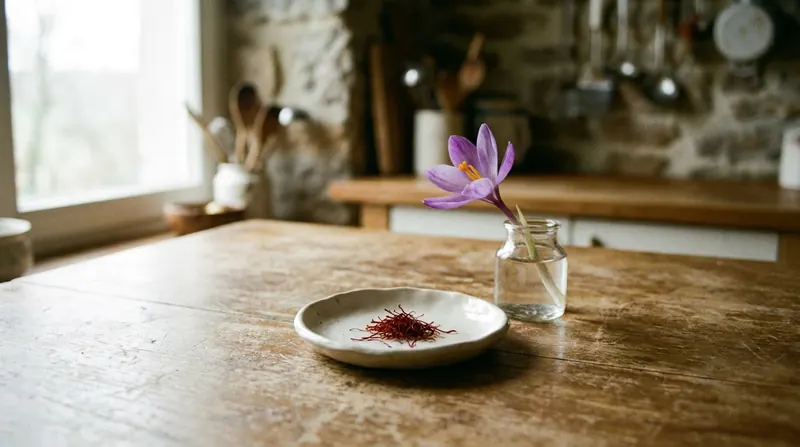
Saffron is the dried red thread at the center of a crocus flower, and it takes something like a hundred and fifty flowers to make a single gram of it.
It is what turns a paella yellow, and by weight it costs more than anything else in your kitchen.
Every thread is picked by hand, in a few weeks of autumn, mostly in Iran, Spain, Greece and India.
That is why a label carrying 32 milligrams of it per serving is carrying something the maker had to pay real money for.
The panel prints 32 milligrams of saffron stigma extract per two capsules.
That is a real amount of a real spice, and it is in the same neighborhood as the amounts used in the saffron studies that exist.
Here is my problem with it, and I would rather tell you than skip it.
I went looking for a study of saffron on memory or attention in healthy adults, or in healthy older adults, and I did not find one I could put in front of you.
The saffron studies I found were run in people with a named condition, which is not the terrain of this page or of this bottle.
A bottle sold for everyday focus does not get to borrow the results of a study in people who were not everyday.
A fair amount of a real spice, with nothing I can cite behind it for a man like you.
So this line gets no mark from me, good or bad.
It is not filler and it is not proof; it is 32 milligrams of a spice whose research was done in a different room.
I want to be careful here, because an absence of evidence gets misread in both directions.
It does not mean saffron does nothing, and it does not mean the maker is hiding anything; it means nobody has run the study that would let anyone say.
If you want to meet the plant anyway, it is cheaper on the spice rack than in any bottle, and a pinch of it in rice is a pleasant thing.
That is not advice about your memory, and I am not offering it as any.
Saffron at 32 milligrams, an amount close to the saffron studies that exist, none of which was run in healthy adults. I cannot tell you what it does in a healthy man of 66, and neither can the label.

The Kitchen Herbs: Eight Hundred Milligrams Shared Between Two Plants
Now the biggest number on the panel, and the one that tells you the least.
The third line reads 800 milligrams of an herbal extract blend, and underneath it, organic spearmint leaf and organic lemon balm.
It does not say how much is spearmint and how much is lemon balm.
Those are two plants you can grow in a window box.
Spearmint is the mint of chewing gum and mint sauce; lemon balm is the lemon-scented cousin your grandmother made tea from.
Spearmint has the better paperwork of the two, and it is worth reading closely.
In a ninety-day study, ninety adults averaging 59 years old took 900 milligrams a day of a spearmint extract rich in polyphenols, and the quality of their working memory scored about fifteen percent better than the placebo group. [4]
The same study reported about nine percent better accuracy on a spatial working-memory task. [4]
And it tested a lower amount as well, 600 milligrams a day, which was not reported to differ from placebo on those measures. [4]
Hold onto that last sentence, because it is the most useful one in this section.
In the only study of this plant run in people of roughly the right age, the lower amount did not separate from the dummy capsule and the higher one did.
A second study, 142 healthy young adults, used the same 900 milligrams a day and found better sustained attention at thirty days and at ninety. [5]
Other measures in that study did not change. [5]
Both studies used one particular commercial extract, standardized to at least 14.5 percent rosmarinic acid.
That is a specific manufactured thing, not spearmint in general, and it is the thing that was tested.
Nine hundred milligrams of one plant, standardized. Eight hundred milligrams of two plants, unspecified.
Even if every one of those 800 milligrams were spearmint, which it is not, you would still be under the amount both studies used.
And because the split is not printed, the honest answer is that nobody reading the label can work out what they are taking.
I asked myself whether I was being unfair, since 800 is not far from 900.
Then I remembered the 600-milligram group, which was also not far from 900 and did not separate from placebo on those measures. [4]
Spearmint's studies used 900 milligrams a day of one standardized extract on its own, and their own lower dose of 600 did not separate from placebo. This bottle prints 800 milligrams shared with a second plant.
Lemon Balm, and Why the Missing Split Is the Real Problem
Lemon balm is the more interesting half of that line, and not in the direction you would expect.
In a crossover study of twenty healthy young adults, single doses of a standardized lemon balm extract improved accuracy of attention after 600 milligrams. [6]
At some doses and times the same extract lowered scores on other memory measures, and after the highest dose, 900 milligrams, people rated themselves less alert. [6]
Read that twice.
The same plant, in the same study, went in two directions depending on how much of it people took and when they were measured.
That is not a strange result in plant research, and it has a plain name: the dose-response curve is not a straight line.
More is sometimes better, sometimes the same, and occasionally worse, which is why the amount on a label is the whole question.
So here is why an unprinted split matters more on this line than anywhere else on the panel.
With lemon balm, more is not automatically better, and this label does not let you know which side of the line you are on.
It also matters for the people who should take care.
Lemon balm has been used for centuries as a mild, settling tea, and the honest caution is that it may add to the effect of anything else that settles you.
If you take something daily in the evening, that is a second question for the pharmacy counter, right after the ginkgo one.
It costs you nothing to ask both at the same time.
I will say one thing in the maker's favor before I move on.
Printing the two plants by name, with the part used and the word organic, is more than most blends do; what is missing is the arithmetic, not the honesty about what is in there.
Lemon balm's own study ran in opposite directions depending on the amount, which is exactly why the missing split is the weakest point on this label.
What the Label Claims, in Its Own Words
Now turn the bottle to the front, because the front is a different document from the back.
The front says the product supports memory function, clear concentration and overall healthy brain function.
That sentence carries an asterisk, and the asterisk carries the standard line that the Food and Drug Administration has not evaluated it.
That is not a loophole; it is the law for every supplement sold in this country.
A supplement may describe how it supports a normal function, it may not say it acts on any named condition, and the asterisk is the seam between those two things.
The maker also says the product helps maintain focus amidst distractions, without the jitters of caffeine.
The second half of that is simply true and checkable: there is no caffeine anywhere on this panel.
No caffeine, no alcohol, no sugar. Four plants, glycerin and water.
I read the front of a bottle the way I read the back, which is to ask which half of the sentence is measurable.
Memory function and clear concentration are not measurable from a chair; the absence of caffeine is, and it is the only part of the front I can confirm for you.
There is one more thing about this label worth a paragraph.
The maker does not describe a mechanism anywhere; it does not tell you how these four plants are supposed to work, and it does not cite a study of its own.
I would rather have that than an invented mechanism.
Half the bottles on this desk come with a paragraph of biology that no study behind the product supports, and a maker that declines to write one has at least declined to make something up.
The front claims support for normal memory and concentration, with the standard asterisk, and makes one claim I can check: no caffeine. No mechanism is described and no study of the product is cited, because there isn't one.
The Word This Panel Does Not Print
Here is the omission I would put second, behind the missing split.
Both of the studies I have leaned on used a standardized extract.
Standardized means the maker states a percentage of a particular compound in every batch, so that 120 milligrams this year is the same object as 120 milligrams last year.
The ginkgo study used a standardized extract. [1]
The spearmint studies used one standardized to at least 14.5 percent rosmarinic acid. [4] [5]
This panel does not print a standardization percentage for the ginkgo, and it does not print one for the saffron.
It prints the plant, the part of the plant and the milligrams, and stops there.
So the 120-milligram match is a match on weight, not necessarily on strength.
That is the single most important sentence on this page, and I have put it here rather than in the ginkgo section so that you meet it cold.
Is that a reason to walk away?
Not on its own: a great many respectable herb companies print the plant and the weight and keep their extraction specification to themselves, and this is a company that grows what it extracts.
But it is a reason to be exact about what the match is.
The weight beside the name is the same weight the study gave people; whether it is the same strength is something the label does not let you check.
It is also the first question I would put to the company on the telephone, since they publish a number.
Ask what the ginkgo extract is standardized to, and whether the saffron extract is standardized at all.
The panel prints plant, part and milligrams, and no standardization percentage for the ginkgo or the saffron. The 120-milligram match is a match on weight; strength is the maker's to declare.
The Directions, and the Small Print Around Them
Three lines on this label decide how the bottle is actually used, and two of them are easy to miss.
The first is between meals.
The maker does not say why, and I am not going to invent a reason for them, but it is the instruction and it is the one most studies of herbal extracts follow.
The second is take as needed, suitable for long-term use.
That is an unusually relaxed instruction for a supplement, and it means the company is not pushing you toward the upper direction.
The third is the caution block, and it has three parts.
Not for use during pregnancy or lactation; ask a healthcare practitioner first if you have a medical condition or take anything daily; and the clotting question I put at the pharmacy counter.
Between meals, one or two servings. Ask first if you take anything daily.
There is no instruction about the time of day, which I think is a small missed opportunity.
If you are going to test a bottle on yourself, taking it at the same hour every day is the only way to compare one morning with another.
Pick your hour before the first capsule and write it down.
Ten in the morning, every day, is a better test than somewhere between breakfast and lunch, because the thing you are measuring moves around during a day more than any capsule does.
One more detail from the panel belongs here.
Five calories and a gram of carbohydrate is nothing at all in a day, and it is worth saying plainly for the men who count both.

The Farm, and the Two Addresses on Paper
This is the part of a label most people skip, and the part I read first.

Gaia Herbs is a company in western North Carolina, and unlike most of the names on that hardware-store shelf, it grows plants.
It runs its own herb farm in the mountains and makes the extracts in the same state, which is a different arrangement from buying powder from a broker and putting it in a bottle.
I put weight on that, and I want to be careful about how much.
Growing your own plants tells you something real about where a leaf came from; it does not tell you that 800 milligrams of two of them will do anything for a man of 66.
A good farm and a weak amount are two separate facts, and a page that blurs them is selling you the farm.
What the farm does buy you is the boring kind of confidence.
A company that owns the field, the extraction and the bottling has fewer places for a batch to become something other than what the label says, and fewer parties to blame if it does.
There is one oddity in the paperwork worth a paragraph.
The label on the bottle prints the company's address in Brevard, North Carolina, and the store's own terms print a different address, in Mills River, about thirty minutes away.
That is not sinister.
The second is where customer service sits, and both are the same company in the same corner of the same state.
But if you are ever going to write a letter rather than make a call, the terms page is the address that answers mail.
I have read listings this month with no street address at all, so two addresses in public is a complaint I am glad to have.
Both addresses are printed, in public, by the company itself. That already puts this bottle ahead of half the listings I read.

Forty-Five Days, and a Telephone Number That Belongs to a Person
I care about return terms more than I care about most ingredient panels, because the terms tell you what the seller expects to happen.
The terms here give you 45 days, and the clock starts on the day the bottle ships, not the day you open it.
If you follow the upper direction, that is four and a half bottles' worth of days; if you follow the lower one, it is a little more than two bottles.
Count that against the test you are going to run.
Twenty mornings at the lower direction, written down, finishes comfortably inside the window with three weeks to spare.
The part I want you to notice is how the terms are started.
You call (800) 831-7780 and press option two, or you write to [email protected], and a person handles it from there.
No portal and no form. A telephone number, printed in public, on the seller's own page.
I have read listings this month with no telephone number anywhere on the site.
A number and an address that a company prints willingly is not proof that a product works, and it is a very good sign about who you are dealing with if it does not.
Two practical notes about that window.
It runs from the ship date, so a bottle that sits in a hallway for two weeks has spent two weeks of it, and the clock does not care.
And if you order two bottles because the second one is cheaper, the window covers both from the same day.
Buying ahead spends your return window on inventory, which is the quiet cost of a multi-bottle order and nobody puts it on the page.
Forty-five days from the ship date, started by telephone or email, from a company that publishes both an address and a number. Read the terms yourself before you order, not after.
Shipping, Price, and the Arithmetic of a Fair Test
Two more numbers before the reviews, and both of them are yours to check on the day you look.
Shipping costs nothing above a sixty-four dollar order, and below that a charge appears at checkout.
This page prints no price, because the price is the seller's to set and it changes, and a printed price on a page like this goes stale in a week.
Look at the shipping line for your own address before you click.
It is the single most common place where a bottle that looked reasonable stops being reasonable.
Now the arithmetic that actually matters.
One bottle is twenty servings, and at one serving a day that is twenty mornings, which is the shortest honest test of anything you swallow.
Twenty mornings is enough to notice a habit and not enough to prove a plant.
I would rather you knew that going in than discovered it on the last morning.
If you want to reach the line where shipping costs nothing, the temptation is to buy two bottles.
The arithmetic says something else: a single bottle plus a small shipping charge costs you less than a second bottle you have not decided you want.
Buy the one bottle and pay the shipping.
If the twenty mornings say anything, the second bottle will still be there, and you will have spent your return window on a test instead of on stock.
Shipping costs nothing above sixty-four dollars, which is the exact pressure that makes men buy two bottles. One bottle and a shipping charge is the cheaper way to find out.
The Reviews: Forty-Eight of Them, Twelve With a Purchase Mark
The seller's page carries 48 reviews averaging 4.4 stars, and its review system marks twelve of them as confirmed purchases.
I read all 48, and then I threw out most of them.
You are owed the reason, because which reviews a page shows you is the whole game.
I threw out the ones about energy, outlook and dreams, because the label does not claim any of that and neither will I.
I threw out one that mixed this bottle in with a list of other products, and the ones written before the bottle had even arrived.
I threw out one about the company rather than the bottle, and one written about somebody else's concentration rather than the writer's own.
And I threw out the ones with a rating and no words, which tell you a number and nothing else.
I kept five, and one of them has a single star, on purpose.
A man who paid for a bottle and got nothing out of it has earned the same space on this page as a man who paid and liked it.
These are real customers, quoted word for word from the seller's own review system; the small pictures beside them are illustrations, not the reviewers.

Makes my mind clearer. I love Gaia's Herbs. I find I absorb them better. Easy to take and clean.

Love this product. I can definitely tell when I forgot to take it.

Love it so far. Have to reorder.

Less than satisfied with this product. I have been using this product going on 2 weeks now and have not noticed any improvement in my overall focus.

I have used these herbs for some years in tisanes either singly or in combination but these capsules with this optimum combination are much more convenient. The capsules are medium size and slip down easily. No aftertaste.
Read those the way I did, one at a time.
Robyn says clearer and easy to take, which is the language of a habit that fits.
Carol says she notices when she forgets it, which is a smaller claim than it looks and a more honest one.
Matt says so far, which is the most truthful two words in the pile.
Ife gave it one star after two weeks and said so plainly.
Two weeks is roughly what a bottle lasts at the lower direction, and he is the only one in the pile who told me what nothing feels like.
The last one has no purchase mark, and is still the most useful sentence there.
She drank these same plants as tea for years and bought the capsule because it is easier, which is the plainest description of this bottle anyone has written.
Not one of the five says their memory came back. Two describe feeling clearer, one describes nothing at all, and the truth sits somewhere between them.
One word about the 4.4 itself.
An average of 48 opinions measures how satisfied 48 people were with a purchase, which is a real thing and a different thing from whether a plant did anything.
The Cheaper Explanations, Before You Spend Anything
There is a conversation I have with every man who asks me about a bottle, and it comes before the bottle.
When a man of 66 tells me he is losing words in the afternoon, the first four things I ask about cost nothing.
None of them is a plant, and all of them are more likely to be the answer than anything on that shelf.
The first is water.
In a study of 1,111 adults aged 60 to 89, the third of them who were measurably short of water slipped faster on a test of processing speed than the rest, independent of their circumstances and health. [7]
A review of eighteen studies covering 33,707 adults over 60 found the evidence tying being short of water to poorer thinking is real but sparse. [8]
That is an honest way to put it, and it is still the cheapest thing on this page to act on.
Two glasses of water before noon costs nothing and is easier to test than a capsule.
The second is the hour.
Almost everybody is worse at names in the late afternoon than at ten in the morning, and a man who only notices himself at four o'clock is measuring the hour rather than himself.
The third is hearing.
Straining to catch a name in a room with a television on looks exactly like failing to remember it, and the difference matters because one of those is worth an appointment this month.
The fourth is the shape of what you eat, over years rather than weeks.
In a three-year trial of 604 older adults, a group eating the MIND pattern of vegetables, berries, nuts, whole grains, beans, fish and olive oil and a group simply eating a little less both improved their thinking scores by about the same amount. [9]
Read that result properly, because it cuts both ways.
The pattern helped, and so did plain attention to what was on the plate, and neither of them beat the other. [9]
I am not putting those four things in front of the bottle to be difficult.
I am putting them there because if one of them is your answer, the bottle will look like it worked and you will pay for it for years.
Water, the hour of the day, your hearing, and the shape of what you eat. Four things that cost nothing, all of them more likely than a capsule, and all of them worth ruling out first.
Six Things Two Capsules Will Not Do
- They will not come with a study of themselves. Nobody has tested these four plants together in anyone.
- They will not bring the two kitchen herbs up to their study amount. Eight hundred milligrams shared, against 900 of one plant on its own.
- They will not tell you how much lemon balm you took. The split is not printed, and lemon balm's results depend on the amount.
- They will not act on anything a clinician has named. This is a dietary supplement and its own label says so.
- They will not settle the ginkgo question. Twelve weeks in 93 people found one result; six years in 3,069 people found none.
- They will not last a month at the upper direction. Twenty servings is ten days if you take two capsules twice a day.
If that list irritates you, I would rather you were irritated now than on the eleventh morning with an empty bottle and no idea what happened.
If You Do Buy It: One Bottle, a Date on the Calendar, and a Notebook
If you are going to try it, try it the way you would try anything else: with a beginning, an end, and something written down.
- Buy one bottle, not three. Twenty servings is a short test and that is all a bottle is.
- Decide before the first capsule whether you are taking it once a day or twice, and write which. The bottle lasts twenty days or ten depending on that single choice.
- Pick the hour and keep it. Ten in the morning every day beats somewhere between breakfast and lunch.
- Take it between meals, as the label says, with a full glass of water.
- Take the bottle to your pharmacist first, with everything else you take, and name the ginkgo out loud.
- Write one line a day in a notebook. Not sharper or foggier: what you were doing at ten in the morning, and how it went.
- Do not start it in the same week you change anything else. One change at a time, or the notebook tells you nothing.
- On the last morning, read your lines beside the same number of lines from the week before you started. That is the only study of this bottle you will ever get.
Look at that list the way I do.
Seven of the eight things on it cost nothing at all.
The notebook is the part men skip, and it is the part that decides whether you learn anything.
Twenty lines written at the same hour will tell you more about your own afternoons than any page on the internet, this one included.
Who It Suits, and Who It Does Not
This is worth a look if:
- You would rather take four plants you can name than eleven ingredients you cannot.
- You have read that the ginkgo is at the amount of a study in men your age, and that the rest is not.
- You will take one bottle as a test with a date on it instead of signing up for a monthly delivery.
- You will ask the pharmacist about the ginkgo before the first capsule.
- You like that the company grows its own plants and prints its own telephone number.
- You have already dealt with the water, the hour and the hearing, and you want to try one more thing.
Give it a miss if:
- You take anything that thins the blood and your pharmacist says to leave ginkgo alone.
- You wanted the spearmint at the amount of its study. It is not there, and the split is not printed.
- You wanted a study of this bottle in men your age. There is not one, and there is not going to be one soon.
- You were counting on a bottle lasting a month. At the upper direction it is ten days.
- You want the standardization percentage before you pay. It is not on the panel; ask them on the telephone first.
Where It's Sold, and What That Tells You
The bottle is sold by Gaia Herbs, Inc. on its own site, and that is the only place this page sends you.
The company grows and extracts in western North Carolina, publishes a street address on its terms page and another on the label, and answers a telephone number for refunds.
Those are not claims about the plants; they are facts about who you would be dealing with.
I separate those two things on purpose, every time.
A company can be easy to reach and honest about its address and still sell you 800 milligrams of two plants with no split printed, and this one does both.
Buy one bottle.
Twenty servings is a test, and the pharmacist comes first.
Read the label you get, then read the twenty mornings you had.
Every plant in the bottle, with its plain English name, the amount the panel prints and the study behind it, is written out in the ingredient guide linked at the foot of this page.
That guide also carries the cautions in full, the references, and the disclosures this page is required to make.
Where to get it
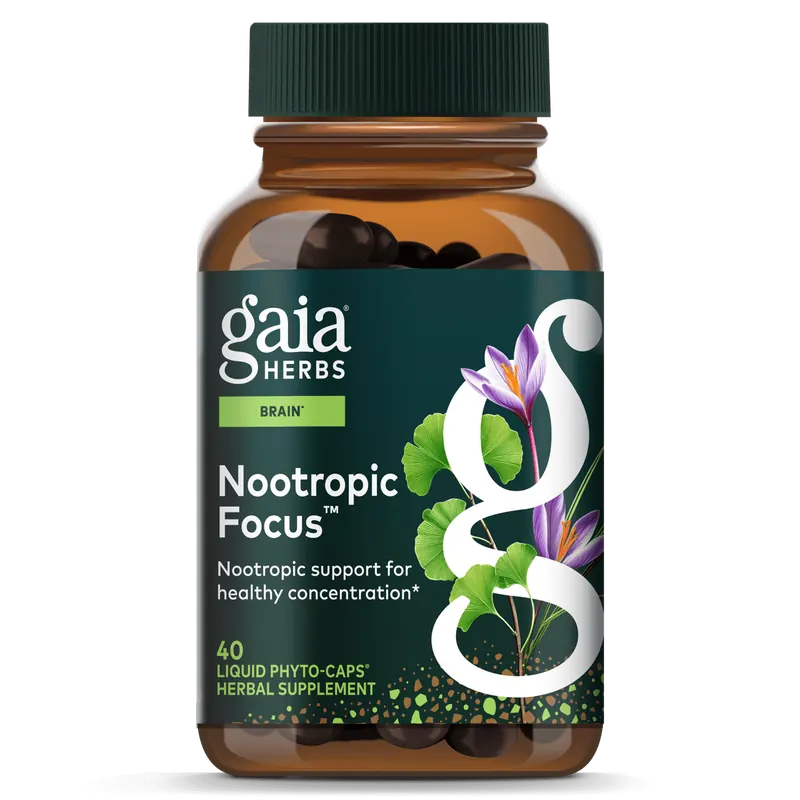
Two liquid-filled capsules of saffron, ginkgo, spearmint and lemon balm, made on a North Carolina herb farm, taken between meals.
CHECK AVAILABILITYSold by Gaia Herbs, Inc., western North Carolina · 40 liquid-filled capsules · 20 servings · two capsules one to two times daily between meals · 45 days from the ship date, started by telephone or email
Questions Readers Ask Me Before the First Bottle
Questions readers ask
Is this medicine?
No. It is a dietary supplement: four plant extracts in a capsule of plant fiber, made and sold by a company in North Carolina.
How long does one bottle last?
Twenty days at two capsules once a day, or ten days at two capsules twice a day. Both are inside the label's own direction.
Which line on the panel has the best support?
The ginkgo, at 120 milligrams, the same daily amount used for twelve weeks by 93 adults aged 55 to 79. [1] The largest study of the herb, at twice that amount over six years, found no difference at all. [2]
Why does the label not say how much spearmint there is?
Because the maker has not printed it. The line reads 800 milligrams of spearmint and lemon balm together, against the 900 milligrams of one standardized spearmint extract used in its studies. [4] [5]
Should I ask anyone before I take it?
Yes, if you take anything daily. Ginkgo may raise the chance of bleeding in people taking anything that thins the blood. [3]
What about the saffron?
Thirty-two milligrams, close to the amounts in saffron studies. I could not find one run in healthy adults, so I have nothing to hand you for this line.
What if I do not like it?
You have 45 days from the day it ships. Call (800) 831-7780 and choose option two, or write to [email protected].
How much does it cost?
This page prints no price, because the seller sets it and it changes. Check the price and the shipping line for your address before you click.
Are the reviews real?
Yes. Forty-eight on the seller's page averaging 4.4 stars, twelve with a purchase mark, and I quote five including one at a single star.
Everything Above, in Sixty Seconds
- A small amber bottle of 40 liquid-filled capsules from Gaia Herbs of western North Carolina; two capsules are one serving and the bottle holds twenty.
- Ginkgo: 120 milligrams, the exact amount of a twelve-week study in 93 adults aged 55 to 79 that found one moderate result on one kind of task. [1]
- The same herb: a six-year study in 3,069 adults at twice that amount found no difference on anything measured, [2] and the official position is that no health purpose is settled. [3]
- Saffron: 32 milligrams, close to the amounts in saffron studies, none of which was run in healthy adults.
- Spearmint and lemon balm: 800 milligrams shared with no split printed, against 900 milligrams of one standardized spearmint extract in its studies, whose own 600-milligram group did not separate from placebo. [4] [5]
- Lemon balm's own results ran in two directions depending on the amount, which is why the missing split matters. [6]
- The panel prints no standardization percentage for the ginkgo or the saffron, so the 120-milligram match is a match on weight.
- No caffeine, no alcohol, no sugar, no gelatin; five calories and a gram of carbohydrate a serving.
- The company grows its own plants, publishes two addresses and a telephone number, gives 45 days from the ship date, and ships at no charge above sixty-four dollars.
- Forty-eight reviews averaging 4.4 stars, twelve with a purchase mark, five quoted here including one at a single star.
- Before any of it: water, the hour of the day, your hearing, and the shape of what you eat. [7] [8] [9]
What Two Capsules Are Actually Worth
Here is the whole thing in one breath.
One line on this panel matches the amount of a study in men the right age, and that line is the ginkgo, which has both the best evidence on the label and the largest null result in the field standing right behind it.
One line is a real amount of an expensive spice with no study I can hand you.
And one line is two kitchen herbs sharing a number that tells you nothing about either of them.
Around all of that is a company that grows its own plants, prints its address twice and picks up a telephone, which is not nothing.
If you are a man who would rather take four plants he can name, who will take one bottle as a test with a date on it, and who will ask the pharmacist about the ginkgo first, that is worth twenty mornings.
Not because of the stars.
Because you will know exactly what is in the bottle, and exactly how far each line sits from the study behind it.
Buy one bottle, ask the pharmacist about the ginkgo, decide once whether it is one serving a day or two, pick your hour, and write one line a day. Twenty mornings in a notebook will tell you more than this page can.
Check the current price and availability
Two liquid-filled capsules of saffron, ginkgo, spearmint and lemon balm, made on a North Carolina herb farm, taken between meals.
CHECK AVAILABILITYSold by Gaia Herbs, Inc. · grown and extracted in western North Carolina · 40 liquid-filled capsules, 20 servings · 45 days from the ship date, by telephone or email
P.S. If you take one thing from this page, take the two numbers.
One hundred and twenty milligrams, the one that matches its study.
Eight hundred milligrams shared by two plants, the one that does not tell you anything.
P.P.S. If the afternoon haze has been with you for a year, and it is there before the coffee too, talk to your own clinician before you buy anything.
A small bottle of plant extracts was never going to answer a question a clinician answers in fifteen minutes and a blood test.